
Your sponsor can't prove it worked.
Three in four say proving return is their biggest challenge. Most spend under one per cent of the budget trying. They will not fix it on their own. The club that fixes it for them gets the renewal conversation.
This is not your sponsor being difficult.
The people writing sponsorship cheques have the same problem you do, and they have had it for years. They are buying more rights and doing less with them.
of brand owners name measuring and demonstrating ROI as their single biggest sponsorship challenge.
WFA with Lumency, Global Sponsorships and Partnerships, November 2025. 41 brand owners across 17 categories, representing US$8.2bn of sponsorship spend.
still invest under one per cent of their sponsorship budget in measuring whether it worked.
Same survey. In 2023 a quarter of brands spent nothing at all on measurement. By 2025 that had fallen to none.
spent on activation for every dollar of rights fee, down from $0.81 two years earlier.
Same survey. Sponsors are buying the rights and then leaving them on the shelf.
Read those together and the shape of it is clear. Your partner has committed money, cannot tell their CMO what it returned, and is not resourced to work it out. Nobody in that chain is going to solve it except you.
The three things sponsors want from a rights holder.
want research on whether the audience recognised and recalled them.
ANA and MASB, Improving Sponsorship Accountability Metrics, July 2018. 182 respondents, fieldwork February 2018. North American sample.
want to know what the audience thinks of them, not just whether it saw them.
Same study, same caveats. This is the oldest evidence here and we have flagged the year rather than dressing it up as current.
want audience demographics. Who these people actually are.
Same study. Only 40% of sponsors write measurement expectations into the contract, which is why most of this gets asked for late and informally.
A fence sign answers none of those three. Not because signage is worthless, but because it cannot tell you who walked past it. An app can answer all three, because every interaction belongs to somebody who opted in and chose to tap.
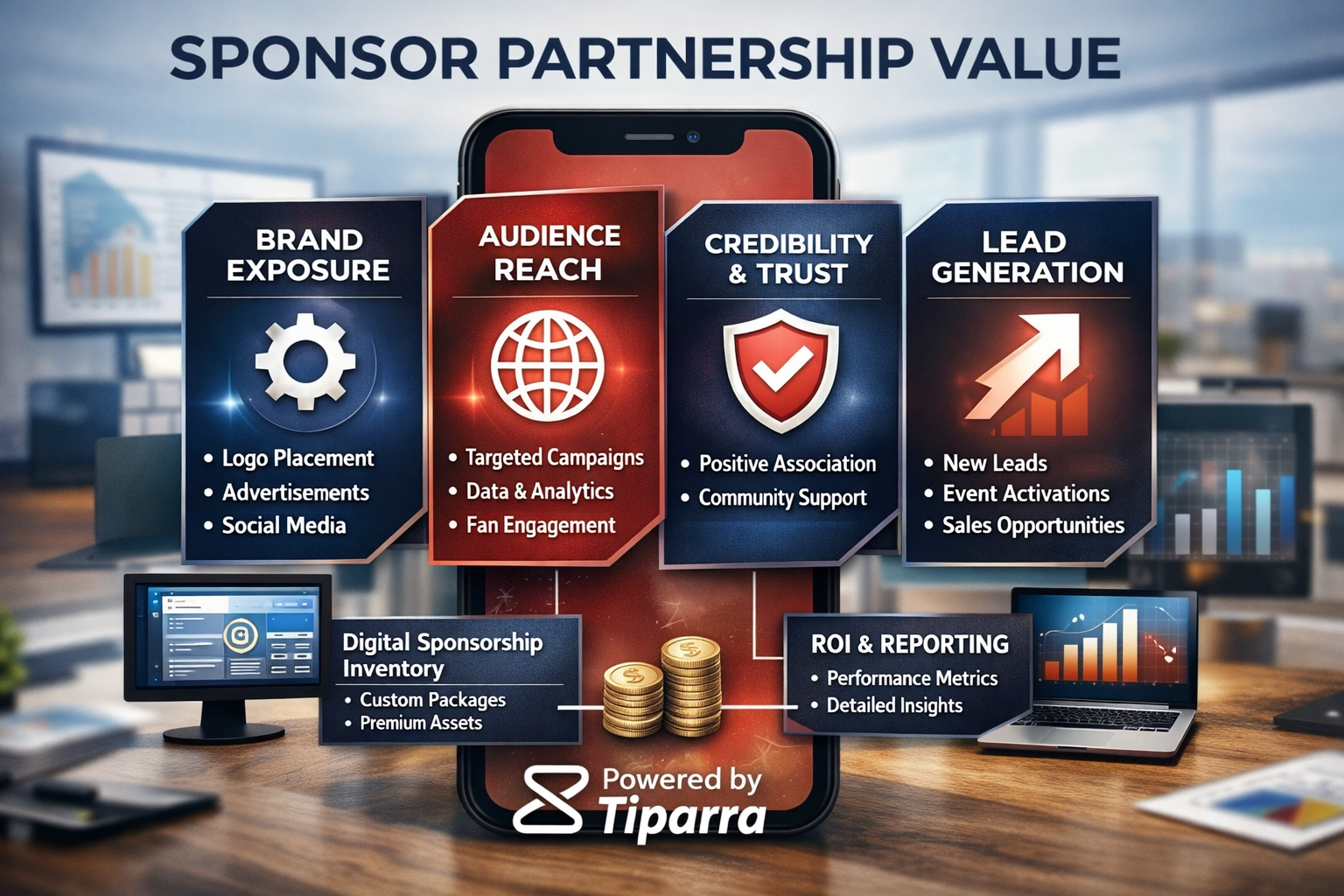
Inventory you can describe, price and deliver.
Four Action Groups, configurable per partner. Every Action is trackable, and every one of them is a decision a fan made.
Sponsored Actions
Poll partnerships, tipping competitions, player-of-the-match votes. The sponsor presents the moment rather than sitting beside it. Fans who take part chose to, and you both see the same count.
Sponsored push
Match-day push, in-app banners, segment-targeted alerts. Opens and taps tell you which partner messages earned attention and which did not, with no platform in the middle deciding what counts.
Partner Offers
Vouchers, codes, ticketed perks, exclusive content. Redemptions tell your partner how many people thought the offer was worth a tap. That is a different number from how many were exposed to it, and it is the one worth having.
The partner report
Everything a partner attaches to rolls into one report. Reach, earned interactions, redemptions claimed, segments engaged. Export it, take it to the review, and stop opening with "we think it reached around".
One page, and the conversation changes.
Partner report, [month] [season]
- Reach. Fans who received the activation, and how many of them were members.
- Earned interactions. Votes cast, polls answered, predictions entered. Things somebody chose to do.
- Redemptions. Offers claimed, and when. The half-time window against the rest of the week.
- Segments. Who engaged, at the level your privacy consent actually permits.
- What we would change. One recommendation for next month, from the club, in writing.
That last line is the one that renews a partnership. A report that only reports is a receipt. A report that recommends is a relationship.
What you are actually allowed to share.
Most clubs believe privacy law does not apply to them. For a lot of them that is wrong, and it is wrong in three specific ways worth knowing before a sponsor asks for a fan list.
The small business exemption is still in force. It has not been repealed, whatever you have read this year.
Privacy Act 1988 (Cth) s 6D. Tranche 2 of the privacy reforms has no Bill and no timetable. Articles claiming the exemption is gone are describing AML/CTF changes that do not cover sports clubs.
Three exceptions catch clubs, and the one that catches most is not turnover. It is being related to a body corporate above the threshold.
OAIC guidance. Most community clubs sit under a state or national body above $3m. Holding health information, such as injury records, also pulls you in regardless of size.
The statutory tort for serious invasions of privacy applies whether or not you are covered by the Privacy Act.
Privacy and Other Legislation Amendment Act 2024 (Cth), Schedule 2, in force 10 June 2025. Being under the threshold is not a defence to it.
The Spam Act has no small business exemption at all, so every club sending marketing email or SMS is bound today at any turnover. In New Zealand there is no exemption of any kind: every club is an agency under the Privacy Act 2020.
One that matters if you have partners across the Tasman. From 1 May 2026, New Zealand's IPP 3A puts a notification duty on whoever collects personal information indirectly. In a club-to-sponsor data flow that is the sponsor. Hand a New Zealand partner identifiable fan data and you have handed them a compliance obligation they may not know they have.
And one thing nobody can tell you yet
Whether a push notification counts as a commercial electronic message under the Spam Act is genuinely unsettled. ACMA has accepted that push tokens are electronic addresses, but it did so under the Interactive Gambling Act and has not issued a position under the Spam Act. Anyone who tells you the answer with confidence is guessing.
The conservative course is to treat marketing pushes as if the Act applies: consent, clear identification, easy opt-out. That is how the platform is built, and it costs you nothing if the question is later settled the other way.
Close to half of Australian community sport has no sponsor at all.
Of 24,154 community sport organisations reviewed, 11,134 had no sponsors on record. If that is your club, the problem is not proving value to a partner. It is having something to put in front of one.
Signage needs a printer, a fence and someone to hang it. Digital inventory needs a Stack switched on. You can describe it, price it and deliver it in the same week you sell it, which is the difference between a sponsorship conversation and a sponsorship.
Data compiled by The Community & Club Collective, reported by Notice Sports, 3 December 2025. TCACC publishes no methodology or data date for this figure, so treat it as directional rather than as a market statistic.
Frequently asked.
Give your partner the number nobody else can.
They cannot get it from a fence, they cannot get it from a platform that owns the audience, and on current evidence they are not going to build it themselves. Twenty minutes and we will show you what the report looks like.
Sources. WFA with Lumency, Global Sponsorships and Partnerships: The evolution of client practices, November 2025 (41 brand owners, 17 categories, online survey mid-2025, US$8.2bn sponsorship spend represented) · ANA and MASB, Improving Sponsorship Accountability Metrics, July 2018 (182 respondents, fieldwork February 2018, North American sample) · Social Status, Facebook organic reach benchmark, 2026 (5.2% is the mean of the January to July 2026 monthly rates, read 1 August 2026) · Data compiled by The Community & Club Collective, reported by Notice Sports, 3 December 2025 (no methodology published) · Privacy Act 1988 (Cth) s 6D and OAIC guidance on small business, trading in personal information and sporting clubs · Privacy and Other Legislation Amendment Act 2024 (Cth), Schedule 2, in force 10 June 2025 · Spam Act 2003 (Cth) ss 5 and 6, and ACMA guidance · Privacy Act 2020 (NZ); Privacy Amendment Act 2025 (NZ) introducing IPP 3A, in force 1 May 2026.
Deliberately absent. No benchmark for app engagement, sponsor interaction rates or redemption rates at club scale, because none exists in published form with a disclosed method. Tiparra platform benchmarks are in preparation and will be published with their sample size disclosed. This page carries no figure we cannot source.
Not legal advice. The privacy section describes published legislation and regulator guidance as at 31 August 2026. Your obligations depend on your structure and what you collect. Check with your own adviser before sharing member data with a partner.