
Beyond the Logo: How to Give Your Sponsors Something They Can Measure
By David Sullivan & James Hodge · Updated
When a sponsor asks what their money bought, most clubs cannot answer. A working guide to running a Partner Offer: how to design it, how to get it in front of the right people, what to report, and what to charge.
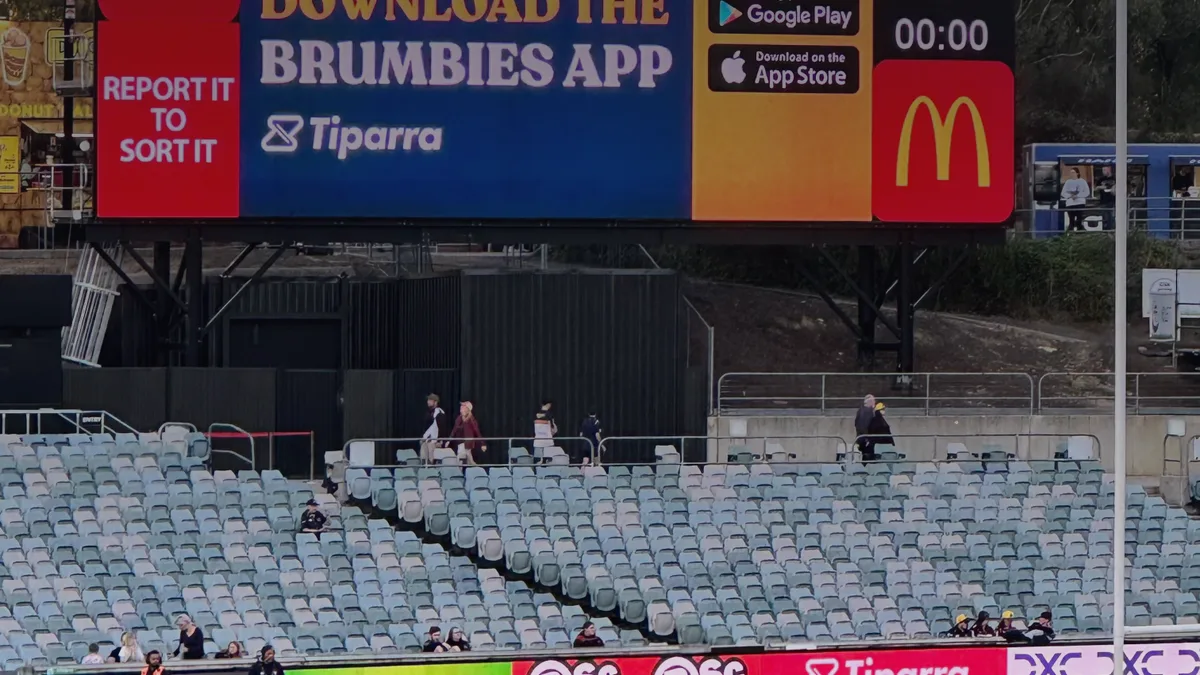
When a sponsor asks what their money bought, most clubs cannot answer.
Ask a club sponsor what they got for their season and most will say something generous about supporting the club. That is a kind answer. It is not a commercial one, and it is why sponsorship is often the first line a business cuts in a tight year.
The problem is not the sign on the fence. The problem is that nobody can say what the sign did. How many people saw it. Whether one of them ever walked through the door. So the renewal conversation runs on goodwill, and goodwill has a limit.
This is a working guide to running a Partner Offer through your club’s app: how to design it, how to get it in front of the right people, what to report, and what to charge.
The thing you are actually selling
A Partner Offer is a different product from a logo, because three things about it can be counted.
- •Who it went to. Not “our supporters”. A group you can describe: junior families, people following the seniors, everyone who opened the app this month.
- •That it arrived. A push notification goes to the people who installed the app. It is not submitted to a ranking system that shows a Facebook post to about 5.2% of a page’s followers, which is the 2026 average measured monthly by Social Status.
- •What happened next. Viewed, and redeemed.
The third one is the shift. It is the difference between selling exposure and selling a response.
Designing an offer that gets used
Most offers fail at the design stage, before distribution has any say in it.
- •Make it worth the tap. “10% off” is not an offer, it is a rounding error. “Free coffee with any breakfast” is an offer. The test is whether a supporter would tell someone else about it.
- •Give it an end. An offer with no expiry gets saved for later and later never arrives. A window creates a reason to act now, and it gives you a clean point to report on.
- •One sponsor at a time. Two competing offers in the same week and neither gets a clean read, which defeats the purpose.
- •One tap to redeem. If it needs a code, then a website, then a form, your numbers will measure friction rather than interest. QR redemption in the app, shown at the counter, is the version that works.
- •Tie it to the reason people opened the app. An offer attached to matchday lands. An offer sent because Wednesday was when you got around to it does not.
What to ask the sponsor for
Sponsors will usually hand over whatever artwork they have. Ask for the right sizes up front and you save a week of back and forth.
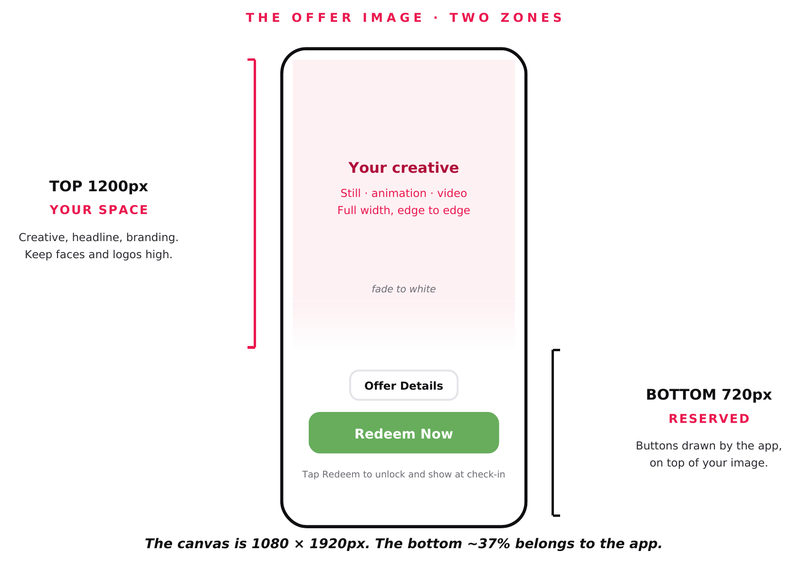
The full image is 1080 × 1920, portrait. The top 1200 pixels are the sponsor’s creative. The bottom 720 pixels must stay clear because the app draws the Offer Details and Redeem buttons over that area. Anything the sponsor puts down there will be covered up, and their designer will not know that unless you tell them.
The banner image is 500 × 200, a 2.5 to 1 ratio, and it needs to be legible small because it is what a supporter sees before they tap.
No fake buttons. If the sponsor’s artwork includes a drawn “Redeem” or “Tap here” graphic, supporters will press it and nothing will happen. The real button sits below.
Rather than writing that out yourself, send them the Offer Image Guide. It has the diagrams, the full spec and a one-page brief a designer can work from. It is the single easiest thing you can do to make the offer look like it belongs in the app rather than like an ad that wandered in.
Three settings that decide whether the number means anything
These sit in the Partner Offer setup and they are the difference between a redemption count a sponsor believes and one they do not.
- •How long the code stays live. Redemption validity is set in minutes, and the QR code expires that long after it is opened. This is the answer to the first question every sponsor asks, which is what stops one supporter screenshotting the code and sending it to forty mates. Short window, honest count.
- •How often the same person can claim. A cooldown set in weeks, days, hours, minutes or seconds, or zero for no limit. One coffee a week rather than one a season, enforced by the system instead of by whoever is on the counter.
- •Whether it costs points. Zero points makes an offer free to anyone. Any other number turns it into a reward that supporters earn. The same tool runs a sponsor promotion and a loyalty reward, which means your points program finally has something to be for.
One more worth knowing: if a sponsor’s till cannot scan a QR code, switch the redemption type to a fixed code the supporter presents instead. It removes the objection before they raise it.
Getting it in front of people
Three routes, and they do different jobs.
- •A push notification reaches the people who installed the app. Use it for offers with a window, and use it sparingly. The fastest way to lose the channel is to spend it on things nobody asked for.
- •A QR code at the ground catches people who are already there and already in a good mood. Half-time on the big screen, on the back of the program, on the canteen wall. It scans to a Stack, which is the landing surface the app uses, so the offer opens without anyone hunting for it.
- •An in-app tile sits there for anyone browsing the app for the draw or the scores. Lowest urgency, longest life.
Most clubs get the best result running the QR at the ground and the push together, then leaving the tile up until the offer closes.
What to send the sponsor afterwards
One page, sent the week the offer closes. Not at the end of the season.
- Sponsor:[name]
- Offer:[what it was]
- Live:[dates]
- Sent to:[the group, in words they understand]
- Delivered:[number]
- Viewed:[number]
- Redeemed:[number]
- Where it came from:[push / QR at the ground / in-app tile]
That is the whole report. It does not need a design, a cover page, or a narrative. The numbers are the narrative.
Two things make it land harder. Send it before they ask. And say what you would change next time: a different day, a longer window, a better offer. A sponsor who can see you are running it as a campaign rather than a favour treats the relationship differently.
What to charge for it
Stop pricing a placement and start pricing a package.
A fence sign is worth what a fence sign is worth, and that is fine. It is the entry tier and it always was. What you are adding above it is access to a defined group with a measurable response, which is a different product and carries a different price.
The practical structure is three tiers. The Supporter is placement plus one thing a fan can do. The Partner adds sponsored push, multiple Actions, and a Partner Offer with redemption reporting. The Principal Partner takes everything, plus splash screen presence, category exclusivity and bespoke activations. Clubs that do this well sell fewer, larger packages rather than a long list of small ones.
The Digital Sponsor Playbook has a tiered framework and a four-step pricing method you can work through for your own club.
A worked example
A regional football club has had the local dealership on the scoreboard for years. The dealership has started asking whether anyone has ever bought a car because of it, which is a fair question nobody at the club can answer.
Rather than renewing the sign on its own, they build a round-nine campaign.
- •The offer. Test drive any vehicle over the next fortnight and get a club-branded gift. Members only, which gives supporters a reason to have an account and gives the dealership a defined audience rather than the general public.
- •The artwork. The club sends the dealership the three specs above. The artwork comes back the right shape the first time.
- •The distribution. QR on the big screen at half time and on the back of the program, announced from the box. A push notification on Saturday morning to everyone following the seniors. The tile stays up for the fortnight.
- •The report. The Monday after it closes, the club sends the one-pager: the group, delivered, viewed, redeemed, and which route brought them.
Whatever those numbers turn out to be, the dealership now knows something it has never known in ten years of scoreboard signage, and the conversation in March starts from data instead of goodwill.
Common mistakes
- •Sending too often. The push channel is finite. Spend it on things worth interrupting someone for.
- •Letting the sponsor write the copy. They will write an advertisement. You know how your supporters talk. Write the headline yourself and let the sponsor approve it.
- •Running it once. One offer is an experiment. Three across a season is a program, and it is the second one where you start to learn what your supporters actually respond to.
- •Reporting only at renewal time. By then the decision is already made.
Where this sits
Offers work because the club knows who it is talking to. That is what a Fan Account is for, and it is worth understanding the layer underneath before you build on it: Stop Renting Your Audience: What Fan Accounts Actually Change.
Social media is still the invite. Your app is the clubhouse. A sponsor offer is one of the better reasons to walk someone from one to the other.
Build the commercial side of your club’s app
See how it works for a community club →
Or start with the numbers: the Club App ROI Calculator takes your member count, your sponsor count and what you currently charge, and gives you something to put in front of a committee. No signup.
Source: Facebook organic reach, Social Status monthly Facebook Organic Reach Rate benchmark, read 1 August 2026. The 5.2% figure is the mean of the seven monthly values published for 2026. Offer image specifications from the Tiparra Offer Image Guide v2.
Article Outline
- 1. The thing you are actually selling
- 2. Designing an offer that gets used
- 3. What to ask the sponsor for
- 4. Three settings that decide whether the number means anything
- 5. Getting it in front of people
- 6. What to send the sponsor afterwards, and what to charge
Ready to Put This Into Practice?
Create your App and see how Tiparra can help your club.
Create your App